
Finished the GED exam! Time to prepare a portfolio for university — here are 6 techniques from P’Lin to make your portfolio stand out 📣
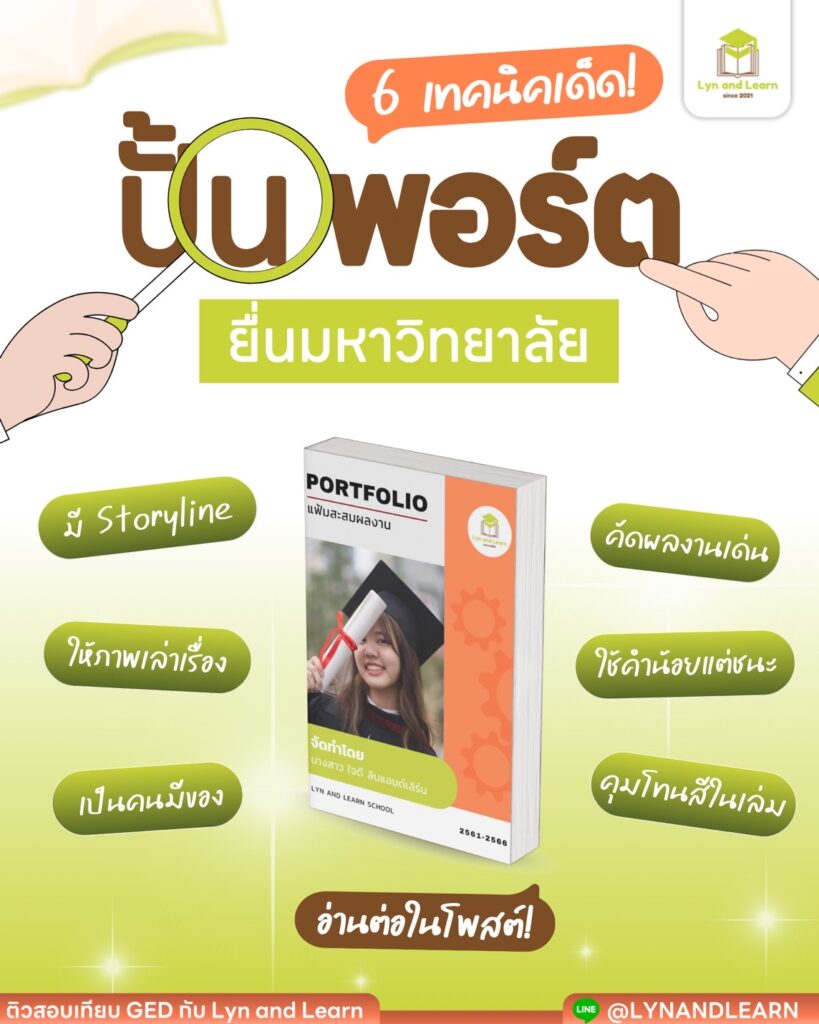
Submitting a portfolio isn’t just about gathering your work, but about “telling your story” in a way that convinces the committee you’re the perfect fit for that faculty. After finishing the GED exam, try these 6 techniques from P’Lin of Lyn and Learn, and your portfolio will instantly shine!!
1. Have a Storyline
A good portfolio is not just lining up works together, but telling “the story of your journey” in a way that comes alive. Every human loves stories, and it’s storytelling that allows the viewer of your portfolio to connect with who you really are.
Start with the beginning – share how you entered this field, or what the first inspiration was that pushed you to pursue this path. It could be a childhood dream, a significant event, or an opportunity that changed your life direction.
Next is growth – this is where you explain what you learned, what kinds of training or experiences shaped your skills today. You might talk about a challenging project that pushed you past your own limits.
Then, present your work – not just showing images or files, but telling the backstory. For example, the problems you solved, your thought process, your design methods, or the real results. This makes each piece not just “beautiful work,” but “work with value and a story.”
Finally, share future goals – because a portfolio shouldn’t only say “here’s what I can do”, but also “here’s where I want to go.” Talk about your ambitions, like wanting to create work that impacts society, joining international teams, or developing deeper expertise. This shows you have vision and won’t stay stagnant.
💡 Example: If applying to engineering, start with school science activities and end with a robotics competition project.
2. Let Pictures Tell the Story
In today’s world, where people consume information visually, images are the most powerful universal language. They can tell stories, convey emotions, and grab attention in a split second. A portfolio that only shows certificates in order may look credible, but it may not be enough to make the viewer feel connected to you.
What makes a portfolio stand out is using action shots or lively pictures—such as working with a team, behind-the-scenes of a project, or presenting your work to others. These images reflect your dedication, skills, and personality far better than static documents.
Photos also create instant stories and emotions. Choose images that capture atmosphere—smiles, seriousness, dedication, or problem-solving moments. That way, the viewer not only sees what you did but also feels who you are.
Think of your portfolio as a movie. The images you include are key scenes telling the story beyond the words. When someone looks at it, they should feel the energy, intention, and charm you’ve put into your work.
💡 Example: A photo of presenting your project to experts, or experimenting in a lab.
3. Show That You’ve Got the Goods
Building a portfolio isn’t just about showing finished works—it’s about declaring to the world: “I’ve got the real stuff.” And “the goods” here means not only tangible works, but also the skills you carry—both hard and soft skills.
Hard skills are measurable abilities, like programming, graphic design, 3D modeling, data analysis, or language skills. These are essential tools that enable you to actually create.
Soft skills are hidden in your mindset and behavior, such as teamwork, creativity, problem-solving, or communication. Often, it’s the soft skills that set you apart, since most organizations want not only capable workers but also people who collaborate smoothly.
What makes your portfolio credible is evidence. Add QR codes or links to short videos where you explain your work, show your process, or share reviews from clients/teammates. This lets viewers see beyond the product—they experience your process and personality.
💡 Example: Instead of writing “I can edit videos,” attach a QR code that links directly to your work.
4. Select Key Works
Many people mistakenly think a good portfolio must include every single piece since high school. But actually, quality matters more than quantity. Including everything can make it cluttered, directionless, and leave readers unsure what your strengths are or where you’re headed.
The way to make your portfolio “shout out” is by choosing standout works aligned with the faculty or career you’re aiming for. For example, if applying to Communication Arts, highlight writing, creative media, video clips, or communication-related activities—rather than irrelevant achievements like sports competitions (unless they connect back to media or communication somehow).
Selecting works also reflects your thinking and organizational skills. It shows you know how to focus and communicate key points. Many faculties and organizations value this ability more than just having lots of average works.
Another technique is adding a short explanation of why you chose this work—such as, “This project sparked my interest in…,” or “This piece demonstrates my ability in… relevant to this faculty.” This helps readers see the reasoning and value clearly.
💡 Example: For architecture, highlight design works, floor plans, and models—skip unrelated activities like singing competitions.
5. Less but Focused
The key to a portfolio is “communicating simply and quickly.” Committees usually have limited time, often reviewing dozens or even hundreds of portfolios. If yours is easy to grasp at a glance, that’s a big advantage.
The technique is less but focused. Don’t write long essays—organize information to be short, clear, and visually easy to read, such as:
-
Use bullet points to separate ideas instead of long blocks of text.
-
Use clear section headings like “Inspiration,” “Key Works,” “Future Goals” so committees can scan quickly.
-
Use short, direct sentences. Flowery language isn’t needed—the important thing is the message: who you are and what qualities you bring.
Also, leave proper white space. Clean layouts that aren’t overcrowded make your portfolio look professional and pleasant to read.
💡 Tip: Highlight important keywords in bold.
6. Control the Color Tone
Another detail often overlooked, but which strongly affects reader perception, is color tone. A good portfolio isn’t just about collecting works—it should show care in design and unity throughout. Color tone control is the simplest way to make it look intentional, organized, and professional.
Choose tones that match your identity and the field you’re applying for:
-
For art/design: bright, lively tones to reflect creativity.
-
For business, management, or engineering: sophisticated, calm tones like navy, gray, or black for reliability.
-
For friendliness and warmth: light or pastel tones to create approachability.
The key is using consistent colors throughout. Don’t switch drastically, like one page bright and the next dark—it breaks unity and looks rushed.
Good color tone control not only makes the portfolio beautiful, but also communicates that you have taste, planning, and attention to detail—all highly valued qualities by faculties and organizations.
💡 Example: Communication Arts could use vibrant tones, while Business could use refined ones.
Anyone interested in joining our GED prep courses, click to check out the catalog! We’ve got both video courses and live classes, plus study sheets too—everything you need, all in one place!!
Lyn and Learn Catalog